Robonaut 2
Also known as R2
n., humanoid. NASA Johnson Space Center with General Motors, United States, 2010. Retired.
First humanoid robot flown to the International Space Station, a dexterous torso that operated station equipment and human tools in orbit.
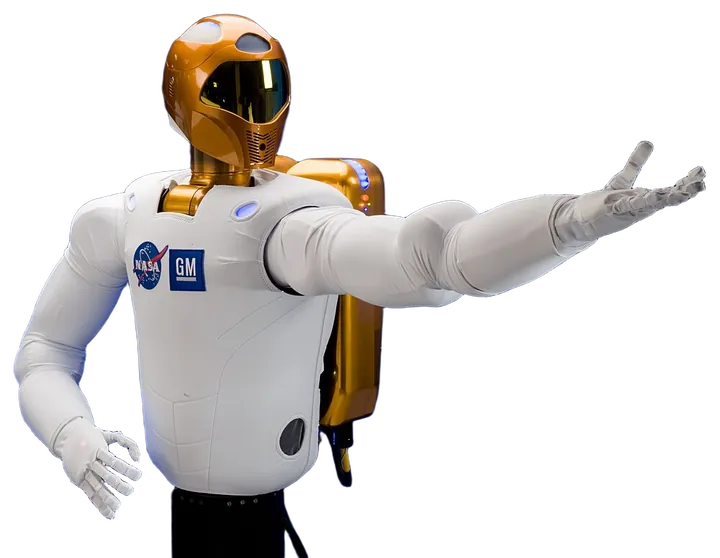
| Maker | NASA Johnson Space Center with General Motors |
|---|---|
| Country | United States |
| First shown | 2010 |
| Status | Retired |
| Mass | 150 kg |
| Degrees of freedom | 42 |
| Actuation | Electric motors with tendon driven fingers and series elastic joints |
| Sensors | More than 350 sensors including load cells in the hands and cameras behind the visor |
| Autonomy | Teleoperated from the ground or the station with onboard force control |
Robonaut 2 measures about 1.0 m from waist to head, weighs close to 150 kg and has 42 degrees of freedom, twelve of them in each hand, with more than 350 sensors and dozens of onboard processors. It launched aboard the shuttle Discovery in February 2011, was activated inside the station and in 2014 was fitted with climbing legs, handling tasks such as flipping switches, measuring air flow and cleaning handrails. A hardware fault ended its work and it returned to Earth in May 2018 after seven years in orbit.
Robonaut 2 launched to the ISS in 2011 as the first humanoid in orbit, worked switch panels and taskboards, gained climbing legs, and returned to Earth in 2018 for repairs it never fully recovered from.
Of note
- First humanoid robot in space, launched in February 2011
- Fitted with climbing legs on orbit in 2014
Sources
- NASA Johnson Space Center with General Motors website, nasa.gov
- Official website, nasa.gov
- Wikidata, Robonaut 2 (Q3437236), wikidata.org
- Lyndon B. Johnson Space Center website, nasa.gov
- Picture, background removed: Robonaut 2 by Robert Markowitz, Public domain, via Wikimedia Commons

See also
Cite this entry
“Robonaut 2.” Robot Dictionary, robotdictionary.com/robonaut-2/. Revised 8 November 2026.
Entry added 14 August 2026, revised 8 November 2026. Suggest a correction or edit this entry.